
Diving into the realm of headless ERP, this introduction captivates readers with a fascinating glimpse into a modern approach to enterprise resource planning. From its innovative architecture to its seamless integrations, headless ERP is revolutionizing how businesses operate in the digital age.
As we delve deeper, we will uncover the key aspects of headless ERP, shedding light on its customization options, scalability, and the industries that stand to benefit the most from this cutting-edge technology.
Definition of Headless ERP
Headless ERP refers to an Enterprise Resource Planning system that separates the front-end user interface from the back-end functionality. Unlike traditional ERP systems, headless ERP does not have a predefined user interface, allowing for more flexibility and customization in how the system is accessed and utilized.
Examples of Industries Benefiting from Headless ERP
Industries such as e-commerce, retail, manufacturing, and healthcare benefit the most from headless ERP systems. These sectors require agile and scalable solutions to adapt to changing market conditions and customer demands efficiently.
- E-commerce: Headless ERP allows for seamless integration with multiple sales channels and provides real-time inventory management for online stores.
- Retail: Enables retailers to personalize customer experiences by integrating data from various touchpoints and streamlining operations.
- Manufacturing: Helps optimize production processes, manage supply chain operations, and improve inventory management.
- Healthcare: Facilitates compliance with regulations, enhances patient care through data analysis, and streamlines administrative tasks.
Advantages and Disadvantages of Implementing Headless ERP
Advantages:
- Flexibility: Allows for easy customization and integration with other systems.
- Scalability: Can adapt to the changing needs of businesses as they grow and evolve.
- Improved Performance: Separating the front-end from the back-end can enhance system performance and speed.
- Enhanced Security: Decoupling the user interface can improve data security and reduce vulnerabilities.
Disadvantages:
- Complexity: Implementing and managing a headless ERP system can be more complex and require specialized expertise.
- Cost: Initial setup costs and ongoing maintenance expenses can be higher compared to traditional ERP systems.
- User Adoption: Lack of a standard interface may lead to challenges in user adoption and training.
Architecture of Headless ERP
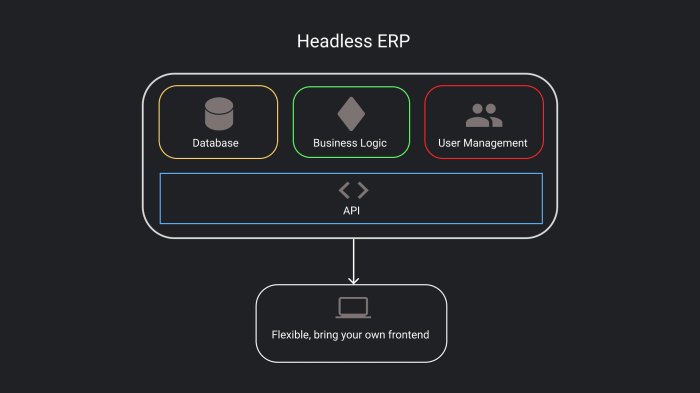
In a headless ERP system, the architecture is designed to separate the front-end user interface from the back-end functionality. This decoupling allows for greater flexibility and customization in how the ERP system is used and accessed.
Detailed Architecture
The architecture of a headless ERP system typically consists of three main components: the presentation layer, the application layer, and the data layer.
- The presentation layer is responsible for the user interface and interacts directly with the end user. This layer can be customized and adapted to meet specific user needs.
- The application layer contains the business logic and processes that drive the ERP system. It communicates with the presentation layer to deliver the requested information or perform specific tasks.
- The data layer stores all the information and data used by the ERP system. It ensures data integrity and security, and is accessed by the application layer to retrieve or update information as needed.
Comparison with Traditional ERP Systems
In contrast to traditional ERP systems, which have a tightly integrated front-end and back-end, headless ERP systems offer more flexibility and scalability. The decoupling of the front-end and back-end allows for easier updates, customizations, and integrations without impacting the overall system functionality.
Decoupling of Front-End and Back-End
The decoupling of the front-end and back-end in headless ERP works by using APIs (Application Programming Interfaces) to connect the presentation layer with the application layer. This allows for seamless communication between the two components while maintaining independence and flexibility.
Changes to the front-end interface do not affect the underlying business logic or data storage, making it easier to update and modify the system as needed.
Integration Capabilities
When it comes to integration capabilities, headless ERP systems offer a high level of flexibility and adaptability to work seamlessly with other software applications. This allows businesses to streamline their operations and improve efficiency by connecting different systems and sharing data across platforms
Challenges and Opportunities of Integrating Headless ERP
One of the main challenges of integrating headless ERP with existing systems is the complexity involved in ensuring compatibility and data synchronization. However, this challenge also presents an opportunity for businesses to modernize their IT infrastructure and leverage the benefits of a more interconnected network of applications.
By overcoming these challenges, organizations can achieve a more holistic view of their operations and make more informed decisions.
- Integration Challenges:
- Compatibility issues between systems
- Data consistency and synchronization
- Training employees on new systems
- Integration Opportunities:
- Improved data visibility and accessibility
- Streamlined processes and workflows
- Enhanced decision-making capabilities
Examples of Successful Integrations
Successful integrations with headless ERP solutions can be seen in various industries, showcasing the power of seamless connectivity and data sharing. For instance, a manufacturing company integrated their headless ERP system with a customer relationship management (CRM) platform to improve order processing and customer service.
This integration allowed them to track orders more efficiently and provide real-time updates to customers, leading to increased customer satisfaction and retention.
By integrating headless ERP with other software applications, businesses can unlock new opportunities for growth and innovation.
Customization and Scalability
Customization plays a crucial role in tailoring a headless ERP system to meet specific business requirements, while scalability ensures that the system can grow and adapt as the business expands. Let's delve into the details of how customization and scalability work in a headless ERP solution.
Customization Options in Headless ERP
- Flexible APIs: Headless ERP systems offer robust API capabilities, allowing for seamless integration with other systems and the customization of workflows.
- Custom Modules: Businesses can create custom modules or functionalities to address unique processes or requirements that are not covered by standard ERP features.
- Personalized User Interfaces: Tailoring the user interface to match the specific needs of different user roles within the organization can enhance usability and efficiency.
Scalability in Headless ERP
- Cloud-Based Infrastructure: Headless ERP solutions are often built on cloud infrastructure, enabling businesses to scale resources up or down based on demand without significant overhead costs.
- Elastic Architecture: The modular and decoupled nature of headless ERP systems allows for easy scaling by adding or removing components as needed to accommodate growth or changes in business operations.
- Performance Optimization: Scalability in headless ERP involves optimizing system performance to handle increased data volume, user traffic, and transaction load effectively.
Best Practices for Customizing and Scaling Headless ERP
- Define Clear Objectives: Before customizing or scaling, establish clear goals and requirements to ensure that changes align with the overall business strategy.
- Regular Review and Optimization: Continuously review and optimize customizations and scaling efforts to ensure they remain aligned with business needs and performance expectations.
- Collaborate Across Teams: Involve stakeholders from different departments to gather insights and feedback on customization and scaling initiatives, fostering a collaborative approach to enhancing the ERP system.
Last Recap
In conclusion, headless ERP represents a paradigm shift in the world of enterprise resource planning, offering businesses unprecedented flexibility and efficiency. As organizations continue to embrace digital transformation, the adoption of headless ERP solutions is poised to soar, ushering in a new era of agility and innovation.
Common Queries
What industries benefit most from headless ERP?
Industries such as e-commerce, retail, and manufacturing tend to benefit the most from the flexibility and agility offered by headless ERP systems.
How does the decoupling of front-end and back-end work in headless ERP?
The decoupling in headless ERP allows for greater flexibility and customization, enabling businesses to tailor the front-end user experience independently of the back-end processes.
What are the customization options available in a headless ERP system?
Customization options in headless ERP systems often include the ability to create personalized workflows, dashboards, and reports to meet specific business needs.